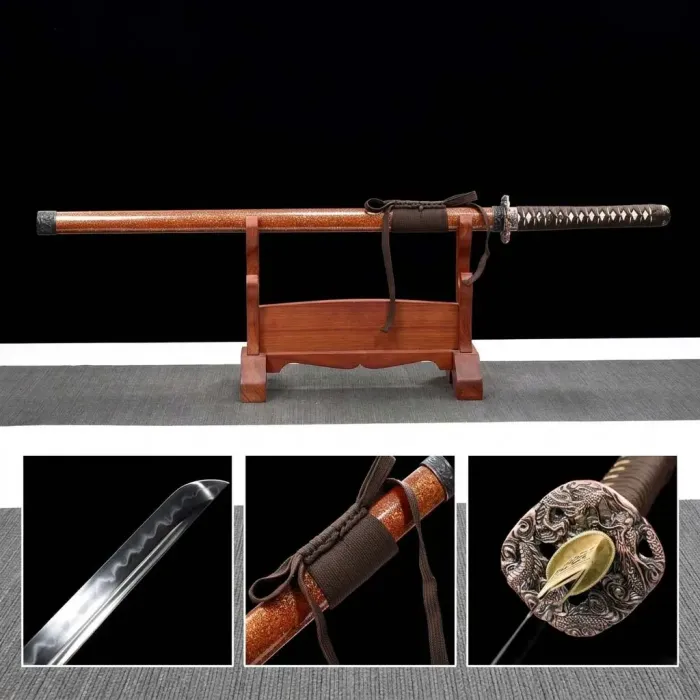
Such age-old eastern blade serves as a impressive example of fabrication, but how about you strive for to express your own style? Adjusting your gear is a rewarding journey, allowing you to build a truly exceptional piece. From the haft wrapping and habaki to the shield design and hamon, each component offers a chance for personalization. This examination delves into the field of katana adjustments, providing facts for both rookies and skilled enthusiasts searching to form their impression on the age-old art of the samurai.
Introductory Genuine Workmanship
For individuals excited to embark on the advantageous journey of classical sword techniques , 1060 steel katanas extend an excellent entry point. This certain grade of elemental-based steel obtains a suitable blend between price and efficiency . While below hard as leading steels, 1060 allows for a manageable level of honing , making it ideal for starters to cultivate the preliminaries of blade preservation and experience the elegance of handcrafted Japanese weaponry. It’s a great choice for acquiring experience without the monetary burden of more complex steels.
Type T10 Cutting Tools : Managing Efficiency and Budget
Enabling fans seeking an authentic saber experience without busting the finances , T10 compound katanas represent a attractive option. These blades offer a noticeable improvement in toughness compared to lower-grade alternatives, exhibiting reasonable edge retention and satisfactory flexibility for initial hacking techniques. While not rivaling the excellent characteristics of top-tier steels like T100 or folded metal , T10 provides a remarkable blend of power and budget-friendly nature , making them a sought-after choice for novices and those on a tight income .
Going past the Keel : Tailoring Your Sword's Fittings and Haft
Whereas the sharpened blade is undeniably the important point of a katana, truly amplifying its beauty lies in the detailed customization of its accessories and grip . This operation allows admirers to showcase their inimitable manner . Think about the comprehensive possibilities: menuki - decorative accents that contribute visual detail ; the hamon enclosures – often intricately molded ; the tsuka basis itself, wrapped in authentic ito rope ; and the fusa butt cap , which can be fabricated from various elements like treasures or antler .
- Adopt styles that match with you.
- Investigate with various components .
- Accent durability for a continuing statement .
The Attraction of the Katana: Legacy, Artistry, and Steelwork
A oriental cutlery shows a distinctive allure, steeped in eras of Japanese history and heritage . More than merely a artificial item of warfare , it's a embodiment of the knight ethos – a fusion of prowess and self-control . Its growth spanned plentiful generations, with early blades evolving into the refined curvature and dangerous edge we accept today. The craftsmanship involved is truly astounding , requiring ages of coaching to complete. The process involves a intricate folding of refined metal , creating layers that reinforce the instrument’s flexibility and slicing ability. Multiple schools of blacksmithing started , each with their special secrets and formulas for achieving the ideal equilibrium and edge - a truly demanding pursuit.
- Primary Katana varieties
- The part of the cutting armament in soldier culture
- Conventional processing practices
Selecting the Ideal Steel for Your Katana Project: 1060 vs. T10
Selecting the right steel is critically important for any sword project, and the decision between 1060 and T10 can be complex. 1060 is a popular American steel, offering a good balance of rigidity and persistence, facilitating it comparatively easy to manage. However, T10, a Oriental steel, frequently boasts increased wear durability and can arguably achieve a greater ultimate hardness, although it can be more tough to treat and requires thorough heat conditioning. Consider your expertise and intended outcomes: for a learner, 1060 may be a more straightforward basis, while the proficient smith might appreciate the increased traits of T10.
- Facility of Processing
- Edge
- Maximum Firmness
Achieving Mastery: Complex Katana Adjustment Techniques
Developing mastery in sword adjustment extends far beyond basic sharpening. Serious connoisseurs are now examining advanced techniques to truly reveal a blade's hidden potential. This demands intricate work with the quenching mark, utilizing specialized materials for differential condition and carefully determining the design of the defense plate to optimize balance and handling. Beyond purely functional tweaks, artisans are increasingly focused on producing unparalleled aesthetic splendor, through complex incising and layered finishes that truly transform a katana into a fine art.
Building a 1060 Sword from Basic Metal to Beauty
The journey starts with average 1060 metal , a strong swords katana material far away the deluxe katana it will transform . Proficient bladesmiths utilize a elaborate process of folding and hammering the primitive steel, repeatedly firing it and pressing it to eliminate impurities and establish a consistent grain structure. This demanding process, often stretching for weeks , builds the crucial solidity and give characteristic of a legitimate Japanese sword . Subsequent heat adjustments , including precise hardening and quenching , are fundamental to achieve the expected harmony of sharpness, permanence and splendor .- Folding: Eliminates impurities and produces grain structure.
- Fabricating: Shapes the steel into the initial blade form.
- Annealing: Establishes the final hardness and flexibility.
The Persistent Magnetism of the Katana: Thorough Examination of Alloy and Modification
That long-standing katana survives a powerful symbol for Japanese folklore, its allure far outshining mere artillery . Forged from select steel and usually featuring intricate designs , the method of creation itself is a respected art. Beyond the primary craftsmanship, the ability to tailor a katana - from the quench mark to the haft wrapping and fitting - affords for a sincerely individual demonstration for both worshippers and followers alike. This amalgamation of tradition-rooted steelwork and boundless personalization creates the katana's continued widespread acceptance across the universe.